



In a Perfect World
This is a dangerous blog post. Partly because it might step on some people’s toes. Partly because I haven’t completed my thoughts on this. So all in all it’s just plain dangerous. But, I need to fill the empty space and this is something I’ve been thinking about a lately.
I’m not sure who first coined the phrase ” in a perfect world” for use in image critique. The first time I heard it was on the old Radiant Vista website. Since then I’ve heard the phrase used a lot by instructors and students alike. The fact is, I’ve used it myself, many times. But it’s something that is starting to bother me. Why? Because the reality is, we don’t live in a perfect world. No matter how much we would like to, we just don’t. So why look at things through the rose colored glasses of a perfect world? Why teach like we live in a world of perfection, when we lived in a world of imperfection?
Often we critique images and say things like, “I like this, but it would be nice if that highlight on your subject’s forehead wasn’t there. I suppose in a perfect world may be you could have waited for them to move a step forward into the shade.” Or, you might hear a statement like, “It’s a nice shot. Too bad you cropped the elbow out. Maybe, in a perfect world you could step back two or three steps and gotten all of it in.” But then we learn later, there was a wall next to the photographer and they could not step backwards or when the person moved, they moved into the light. It’s the world we live in. Why not learn to critique in an imperfect world and accept photos for the imperfect images they are?
Would we really have the guts to critique some of the of the most influential photographs of our time with the same statement?
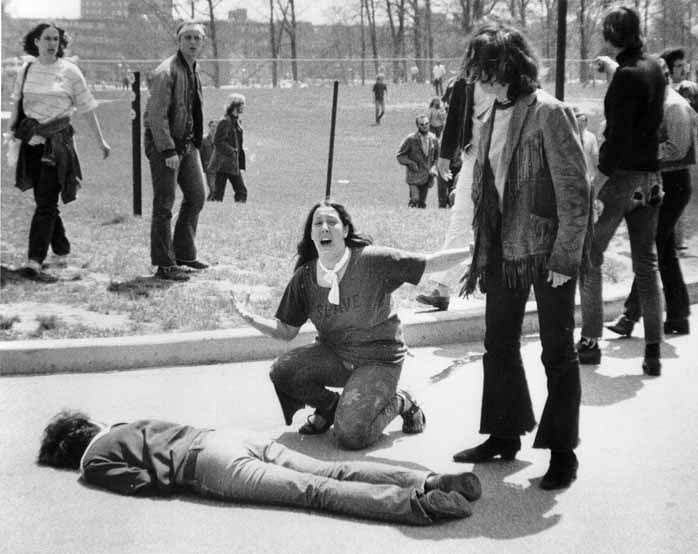
Photo by John Paul Filo
Let’s look at this famous image by John Paul Filo. I’m sure you recognize it, was instrumental in turning the tide of support for the Vietnam War. Kent State and other universities students were protesting against President Nixon sending more troops into Cambodia. The Ohio National Guard was called out and ended up shooting and killing four students. If we were to critique this image, we would say the first thing that’s unfortunate is the poll growing out of the woman’s head. Secondly, it was unfortunate timing to have a man walking behind the man the foreground. He creates a distraction and makes it difficult to see clearly the man in the foreground. This shot was about timing. It wasn’t set up. It wasn’t composed. It was snapped. Action and emotion were caught on film forever. This was a decisive moment. This photograph won a Pulitzer prize. The photo was also memorialized in a Neil Young song and in a TV movie. I don’t think anyone even dared say to Filo, “in a perfect world.”
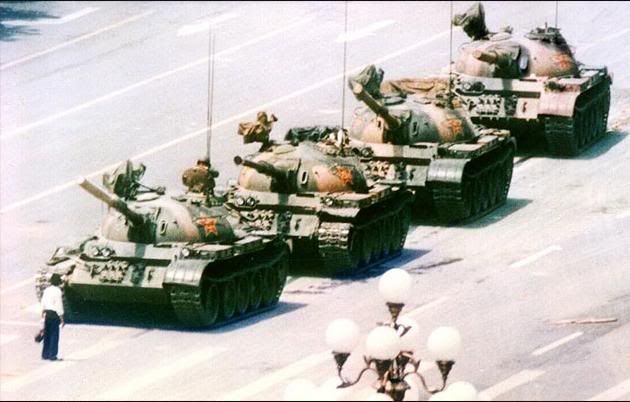
Photo by By Jeff Widener
Here is another image, the famous image by Jeff Widener. It is of a lone man and that stands up against the tanks at Tiananmen Square. Interesting enough there are several images of this event. There is even one shot from a higher angle that doesn’t have a light post in image. But this one seems to be the most widely used from that day. If this image was shot today there’s a good chance those lights would be cloned out. In a perfect world, maybe Widner would’ve run to different room and shot this from another angle to loose the light post. But the Widner didn’t live in a perfect world. In fact, that’s what he was photographing, a very imperfect world. By the way, Widner was a nominated finalist for the 1990 Pulitzer for this image.
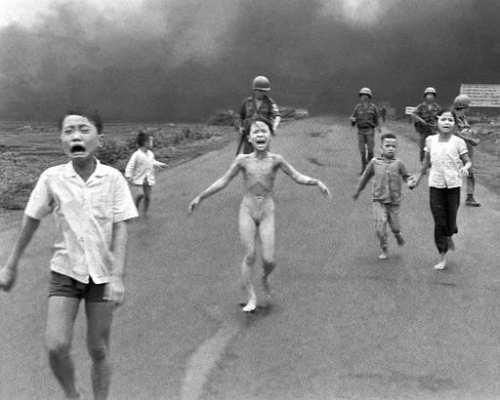
Photo by Nick Ut
Then there’s this unbelievably powerful image by Nick Ut taken June 8, 1972. His picture of Phan Thị Kim Phúc, who was photographed as a naked 9-year-old girl running toward the camera to flee a South Vietnamese napalm attack won another Pulitzer prize. But, come on Nick! Couldn’t you have shot the scene a few seconds earlier so you would’ve gotten the boy on the left completely in the frame? What came over you? I guess Nick Ut and the Pulitzer committee understands they don’t live in a perfect world.
I could go on and on, but I think you get my point. A photo is not meant to be perfect. Does it help to critique or teach students what to do in a perfect world? I’m not sure, I’m still processing this question. But my gut feeling is no. I think it might be better if we critique the image as it is. Knowing we live in an imperfect world. We can say, “I would like to have seen the feet and hands in this photo. But it doesn’t take away from the impact. I love it and well done.”



I couldn't agree with you more Matt & well said!
It's a difficult subject for many reasons and one which probably isn't helped by the word 'critique' itself which to me always suggests criticism & similar negative connotations. I know criticism can be, and often is, constructive but as you say at the end, you love the image and its impact. Perhaps we (that is to say, photographers) should build from that, describing what is best in an image, rather than 'critiquing' and therein subtracting what we subjectively see as wrong?
Thought provoking post.
My first reaction is that the examples you have used here are dated. I'm not trying to be difficult, but contemporary photojournalism tends to be as much about photographic technique as it is about the subject. I'm not sure this was necessarily the case the the 60s and 70s.
The difference, I think, is that contemporary photography exists within an era of image saturation that is like nothing that has come before. Joe Average may find the term 'visual language' to be arty-farty crap, but his ability to read imagery is acute, even if mostly intuitive. Creators and judges of photography, therefore, need to be even more sophisticated in their execution and understanding.
Coupled with the fact that photos of important events can come from many sources – images of 9/11 are a good example – the Pulitzer winning photographer of the 21st century will not be the guy with an iPhone who happened to be in the middle of an historic event.
However, I'm not just being an argumentative arse. 🙂
I think your actual point is that the photographic community spend too much time focusing on the details rather than the broader picture. And in this spirit I couldn't agree more. Every time I venture into critique forums I get put off by the fact that mostly the focus of criticism is that lamppost in the corner, or the smudge of trees in the background.
I understand that an image can be looked at graphically, but that is only one way of looking. Photography has greater breadth and depth, and discounting an otherwise interesting moment because the layout within the photographic rectangle isn't 'perfect', can be….I don't know…superficial.
I think that context and intent are important. These are news photos. I would expect one to critique them based on different criteria from, say, lifestyle photographs.
I think that it's important to ask the “what if” questions, but it's also important to realize that we can't necessarily know the answers. We can ask “what if you had moved a bit to the left”, but the reality is that unless we actually do so we can only guess at the outcome. Yes, we can reasonably visualize the change in perspective, but we can't see what might suddenly enter the frame. In the same way, we can only guess at the possibility to actually move to the left; maybe there's a 1,000 meter drop off to the left!
Perhaps there is middle ground. Photos need to be critiqued for what they are and not compared against what they're not, but I also think that we need to ask some of those “what if” questions in order to inspire people to look for different perspectives, different lens choices, etc. We just can't guarantee that those what ifs would have improved the photo. They'd simply have improved our understanding of the existing photo – for better or for worse.
When I first started listening to Criag Tanner's daily critiques over at the Radiant Vista, I was put off by his use of the phrase as well. After hearing his defense of it one day I came to accept the use of the term. Certainly we live in an imperfect world, but when a photo is presented for critique, ostensibly the photographer wants suggestions for improving their work as a whole not just advice on how to improve that specific image. Use of the perfect world standard gives the reviewer some latitude to make suggestions that might not have been an option, but may help the photographer see ways to improve their images the next time they have a similar opportunity.
(Apologies if this shows up twice, first attempt didn't seem to work)
It is true we don't live in a perfect world, and I think for students of documentary or photojournalism in particular, your sentiment is on the mark. Part of teaching should be to acknowledge the chaos and imperfection of the world being photographed. However for fine art photographers and others, I think it makes sense to teach people to pay attention to what's in (and out of) the frame and try to minimize distracting elements or relationships between elements as seen through the lens.
I'm loving the discussion here. You guys make some great points. I do believe that what I'm saying applies more to street photography and photojournalist than other types of photography. And I understand the use of the term as Craig Tanner defines it.
As I stated in the post, this something I am working through. I don't have it resolved in my mind yet. Maybe it's just the phrase is so overused nowadays. However, if I was a student and I had just made a photograph that I was proud of and someone who I consider is as a peer (I think this might be factor for me – who is doing the critique?) looked at the image and told me how I could have improved it by standing somewhere else or waiting a few seconds longer kind, just kind of chaps me. I think everyone needs to see what's lacking an image, a clean background, the lack of a finger or toe. But if the image communicates, and is expressive and effectively tells the story, then we need to give the student a hearty well done. I think Cathy make a great point, what are we focusing on? The minutia or the story?
Cathy, Thanks for your post. I love the way you think. I'm not convinced we have different standards for judging classic work versus contemporary. But it does make one stop and think.
By the way I'm enjoying your blog. Thanks for contributing.
I think we've skipped a step here by not asking what the purpose and context of the critique is. The “perfect world” scenario can be incredibly helpful or moronic, depending on why we're looking at the image critically in the first place. If what we're doing is asking, What can I do differently next time when a similar situation arises? then I think it's important to give serious consideration to every element that is included, or excluded, from the frame. If we “critique the image as it is” what do we have left if there's no way to say, Here's how it might have been made stronger. I use the “perfect world” as a disclaimer because I know that while I can make suggestions I was not there and am unaware of the constraints that actual reality imposes on the frame. Still, I think it's helpful and needn't detract from the image as it is. Another way of saying it might be, “All other considerations aside, this image might have been made stronger in the following ways even though at the time it might not have been possible for any number of reasons, it might be next time, so listen up.” But that takes too long to say.
I may be reading this incorrectly, but it sounds more like the issue is with unsolicited critique than with the perfect world standard. Unless I've specifically asked for critical feedback of an image, I'm usually more interested in overall reaction to the shot, whether it has impact or effectively conveys the point I'm trying to make. I find it annoying when people point out minor issues like a cut off finger or a pole sticking out of someone's head, because I can't help but wonder if that's all I was able to convey in the shot.
David-your point is well made. I guess it's just the irritation of knowing we don't live in a perfect world, so why do we keep using that statement. Maybe it's just semantics. It irritates the heck out of me. Why compare to something that doesn't exist. If we want to say is “all considerations aside” then let's just say it. In a perfect world I'd be shooting with a DS MK1 but I don't.
Marcus-I think you definitely hit on some of irritation for me. Though that's not the whole story. But I certainly am with you, can't stand unsolicited criticism especially when it focuses on minutia, and then misses the very point of the image.
I think it's semantics and in the big picture is it the words themselves that bother you or the growing desire to shoot – and look at – images that are more documentary in nature and therefore not as easily simplified with the “perfect world” critiques. You have to admit the nature of your work is changing and so the language with which you interact with that work will also change. For some of us the “perfect world” thing is less an issue than something else. But we've all got hot buttons. In a perfect world you'd let me use the phrase “in a perfect world.” 🙂
Does “perfect world” even apply to what are essentially breaking news photographs? And if it does, wouldn't it then remove the need for the photo anyway, because in a perfect world, the tragedies above would never have happened, and thus never have been photographed?
Perfect world can apply to set up shots, or even street photography where the photographer positions him/herself in the right place and waits, or any shot where time is not a factor.
At least that's what my brain says at 11:30pm after a long day.
My short take on many critiques is rarely is the story or point of the image ever talked about. Minor imperfections that some believe are the 'rules' of good can be forgiven if the content has power. My first look is always does it make me feel something, then if it doesn't why not. Does anyone ever critique the subject of the image. To often, all most critique and the rules is doing is putting 'fancy' on boring. Technically good and it follows all that is accepted as good but why did you bother making that image?
This probably isn't as clear as it should be for a public forum but some of you will get the point. Good subject and thought on this Matt. I often wonder if people stare through a viewfinder so much they don't really see anymore they just look. With out something to say it doesn't matter how 'good' it is. Following the critique/rules for any of the images above I don't believe would have added a noticeable difference to any of the images you used for the post. (Key word: noticeable).
ohhh i can't imagine the situation over those places…
Some great points here and if I can chip in again….
The last couple of points (Marcus & David) hit home with me because like Marcus says, I too really hate it when people start pointing out minute things that they consider to be wrong with an image. Sure, if the horizon's tilting a couple of degrees out or there are dust spots in the image then fine, point it out, but the other stuff? Who's to say I didn't want to include that person who's walking out of the frame, just to annoy people who think everything should comply to the rule of thirds? If we stick to the rules too much we all end up playing the photographic equivalent of classical music and nobody's knocking out the rock n roll. There's room for both.
David wrote “Here's how it might have been made stronger” and I think it's that statement which is fundamental. When I read David's first book, my photography improved massively, not because he was telling me what was wrong with my images (how could he, it's a book) but because it gave me “ideas overload' for how to make my images stronger. By focusing on how we can make images stronger we pay respect to the creator of the image and help them to create their own style. By saying “this is wrong, that's wrong, you should/could have removed that object” we put down the creator and their work and inadvertently create conformity.
sorry, went on a bit more than intended. I'll shut up 🙂
Interestingly, Life Magazine published the “perfect world” version of the Kent State photo:
http://graphics8.nytimes.com/images/2009/08/22/…
story here:
http://journalism_jobs.tripod.com/a.filo.html
Before I read the comments I was thinking of a Within the Frame podcast where David showed a well composed photo and talked about why it worked. Then he mentioned “in a perfect world” if there was a person walking over there… At the time my initial reaction was WTF, that picture is awsome why search for something to bash!
He then went on to explain that the image would be stronger with this other element not that the lack of it made the image a poor image. I remember at the time taking note of that language for when I talk about images. I think it is helpful.
It's also funny to me how people feel it is almost their duty to randomly critique an image but would be reticent to do the same with a piece of writing. I rarely see “too few comma” or “not enough colon” posts on peoples blogs. I guess everyone with a camera is a photographer.
This discussion reminds of the many discussions and lectures I attended while in nursing school. One teacher in particular would say, “in perfect hospital USA…., but in the real world…”.
If I had plenty of time to weigh ALL the options about what was best for a patient I may have gone a different direction. But I don't. I have to do it quickly and as accurately as possible. My goal is keep them alive. In a perfect world I may have been able to push a life saving drug while calling the surgeon to update on the patient's status, but in reality, I pushed the drug and got stuck on hold with the answering service before deciding to try something else.
We can critique photos all we want, but I think some of the best photos are those that capture the magic or horror in that split second and if the photographer tried to reposition or change a setting they may have missed it. Does the first photo mean less to me since she has a pole coming out of her head? Absolutely not. In some ways it feels more real, more visceral.
As a photographer and an RN the questions are essentially the same–did I tell the story and convey the emotion as effectively as possible in the time and space I had.
Really interesting discussion here. What I'm left thinking about isn't what's in the frame… those things are easy to critique. Instead I'm thinking about what was not included in the frame. It's a difficult decision to make in tiny time frames. It's likely that even a step to the left or right in many situations reveals a much different story.
Perhaps because my photography skills are limited, I see this more from a story perspective than a graphic one. The inclusion of the light pole in the Tiananmen Square image establishes both pov and time (in 20 years it'll be easier to date that lighting than the tanks or the man's clothing). The awkwardly positioned people in the Kent State image illustrate well the chaos of the moment. I could go on, but I think you get my point. Perhaps part of the equation isn't just learning to make a good photograph as a photographer, but learning to read a photograph well, and recognizing that each element speaks.
Matt,
Excellent post. I think there's a major expectation differential between fine art and journalistic photographs. I think we (photographers) tend to see “perceived” distractions that would otherwise go unnoticed by most. Personally, a strong journalistic photograph boils down to compelling content— if an image has a strong visual content that provokes a solid emotional response then it's success regardless of other distractions (e.g. a soft image, poor framing). Fine art/commercial photography has much higher bar (aesthetically) and I think the need for a perfect world has been heightened by the ease of photo-editing tools. I'm the very first to admit to using whatever tools are at hand to improve my images. But, it's a balancing act when we're talking about the journalistic integrity of an image. I think it's a growing gray area that will only become more complicated/subjective as technology moves forward.
Doug-interesting discussion here. Looks like Life got into some deep kimchi over it as well. But you're right, it looks like someone at Life decided they wanted to live in a perfect world.
Erika-I think you've nailed it. I think this is what I am objecting at a gut level. I think it's okay to say, “in a perfect world” as long as we recognize can teach with the real world in mind. I guess I don't think a student should be reprimanded or chased for something they had no control over. But certainly we need to understand, as others have pointed out, principles of good composition and teach those.
John- Your point, and others as well as the point others have made, is absolutely correct the argument is really made from a street/photojournalist standpoint, where the environment controls the photographer not the other way around. In art/commercial photography as in film for the cinema, there is no real world, it's all perfect. As a result, you can do what you want, you can stand where you want, you can light what you want. So there's no reason for an elbow being cut off or shadow across the face, unless you meant for it to be there.
Thanks Matt. Your encouragement really means a lot.
I've gone through a similar process on this exact phrase. I think I take critique that is based on a perfect world to personally, even though I shouldn't. What I need to do is take it objectively and hunt after that moment each day.
Good thoughts!
Great post, Matt. You're right, all those photos were amazing because they captured incredible human moments and the emotions in those moments, not because they were technically perfect or photoshopped within an inch of their lives. Thanks for posting this. A lot of people need to read it.
Thanks Scott for chiming in after south time has passed with this post. This is one of those topic that stays relevant.