


Exposed #2


This is not one of my strongest images, but it has a joy about it that makes me keep coming back to it. Here is the story behind it. This image, like the last one, was taken on a Lumen Dei workshop (See, if you join us you will have a great many new additions to your portfolio.). I was at the Taj Mahal walking around looking for something or somebody interesting to photograph. I had just walked out of the mosque that is to the right of the tomb and I saw a whole family sitting around a park bench taking family snaps. Several of the children where beautiful and I really wanted to shoot their portraits. So, being the manipulator I am, I walked up and offered to shoot the snaps for them so all of them could be in the photos and of course they obliged. I took one shot with this camera and another with that. We have all been there, three camera hanging off one hand and two more off the other and then mine all weighing me down. I must have looked like a walking camera salesman. “Psst! Hey buddy! Wanna buy a camera?” So I took the shots and then managed to throw enough guilt at them to let me take each of their images on the wall of the mosque behind me. At first they just posed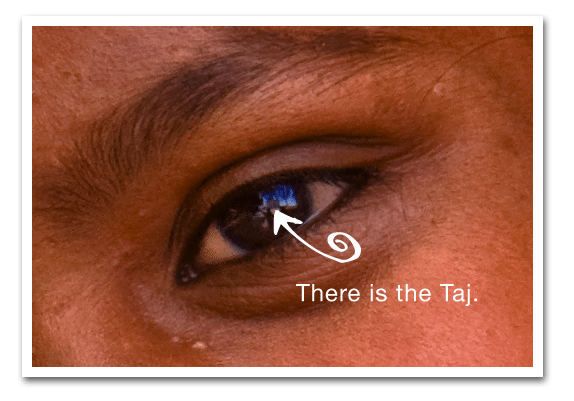 straight faces and solemn. Like they were a part of the stone structure it’s self. Then I started making google eyes and laughing at myself. Remember laughter is contagious. I often will start laughing when I am shooting a portrait on the street to get the subject to giggle or laugh. Works well.
Why does this image work? One of the first reasons is the gesture, the laugh. Here again, we come back to the same reason the catch light is so important. Just like a catch light, the laugh brings the image to life. Laughter make the person real – a human – and the viewer can relate. Speaking of catch light, you see again in this image. This time it is so clear and sharp you can actually see the Taj Mahal silhouetted behind a blue sky in her eyes. Barely, but it is visible. (Click on the image to the right for a close up.
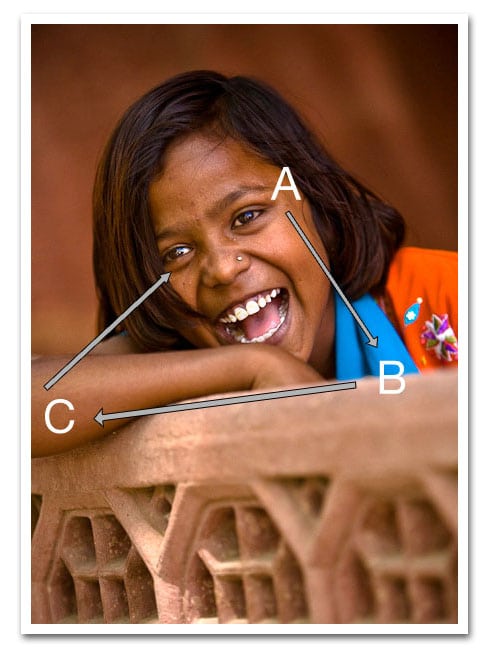 Compositionally what makes this a stronger image is the triangle formed by the her posture, the railing and her elbow. The viewer naturally starts at her eyes, then your eyes move to the railing and up the railing to her elbow and then back to her eyes. All this is done in seconds and probably several times over as you view the image.
The triangle is one of the most common compositional forms found in images. I think, because things bend and connect and turn; like arms, branches, buildings. Maybe because lines converge and when they do, often a triangle is formed. Whatever the reason, they are everywhere. Triangles are useful in an image as they draw the viewers eyes along the path from point A to point B to point C and back to A. So your eye has a natural path of movement through the frame and this is really import. It is important because the last thing you want to have is a stagnant image, one without
movement and boring. The opposite of a boring image is a busy one, an image where all the elements compete with each other for the viewers attention. Either way, the picture loses the viewer’s interest and that is a bad thing.
So there you have it. A laugh by the photographer, a giggle by the subject and some nice light, mixed them together and get a decent portrait.


You are wrong O master. Your eye will first go to the brightest spot on the picture, especially if there is a big one, like her teeth. Then it will go up to her left eye (second brightest spot) and then to the next thing in focus, which is the rail she’s leaning on-the lower part that the focus is on. Your eye wants to do a lot of things when looking at something like a picture. First, brightness, then either the color red or readable print, then focused spots if there is a lot out of focus. And subconsciously it will flow around the picture or right out of the image depending on what’s going on. Just a little information from someone who’s taken a pic or two.
Keith, you are absolutely right about the brightest spot. This true, but I am not sure the white of this little girls teeth cause the eye to do that here. But a good addition to this lesson, oh wise one. Thanks.
On this shot you definitley go to her teeth first, but thats OK. And your A,B,C triangle is correct and your eye wants to stay in this photo which as you know is a great and somewhat rare feat. Anyway when am a going to be your friend? Website, that is.
KT
Matt
Somewhere, I can’t find it, you asked for suggestions re place for next Lumen Dei workshop. Well, I have been thinking about it and I would love to go somewhere in India….. For me, it is probably not somewhere where I would travel by myself (I think I would just be overwhelmed and end up a bit paralysed in one place) and my husband doesn’t have any interest in travelling to India. So, for me, to do it as a group, with the intimate knowledge that you and David have of both the country, the people and photography, would be a brilliant opportunity. I realise that you are already in Ladakh in Sept of this year so it may be that everyone wants somewhere different from India….anyhow, just thought I would throw the suggestion out there.
Matt
Somewhere, I can’t find it, you asked for suggestions re place for next Lumen Dei workshop. Well, I have been thinking about it and I would love to go somewhere in India….. For me, it is probably not somewhere where I would travel by myself (I think I would just be overwhelmed and end up a bit paralysed in one place) and my husband doesn’t have any interest in travelling to India. So, for me, to do it as a group, with the intimate knowledge that you and David have of both the country, the people and photography, would be a brilliant opportunity. I realise that you are already in Ladakh in Sept of this year so it may be that everyone wants somewhere different from India….anyhow, just thought I would throw the suggestion out there.
Neddy, I have a talk with David. But I think Delhi and some part of Kashmir will always be on the agenda. Maybe you can join us next year?
Yes, that is what I am hoping to do 🙂